
Economic Event Volatility Intelligence
Prepare for scheduled market events with pair-specific, one-hour volatility estimates delivered for the next seven days. Use the data to inform pricing, liquidity, routing, hedging and exposure controls within your own dealing-desk framework.
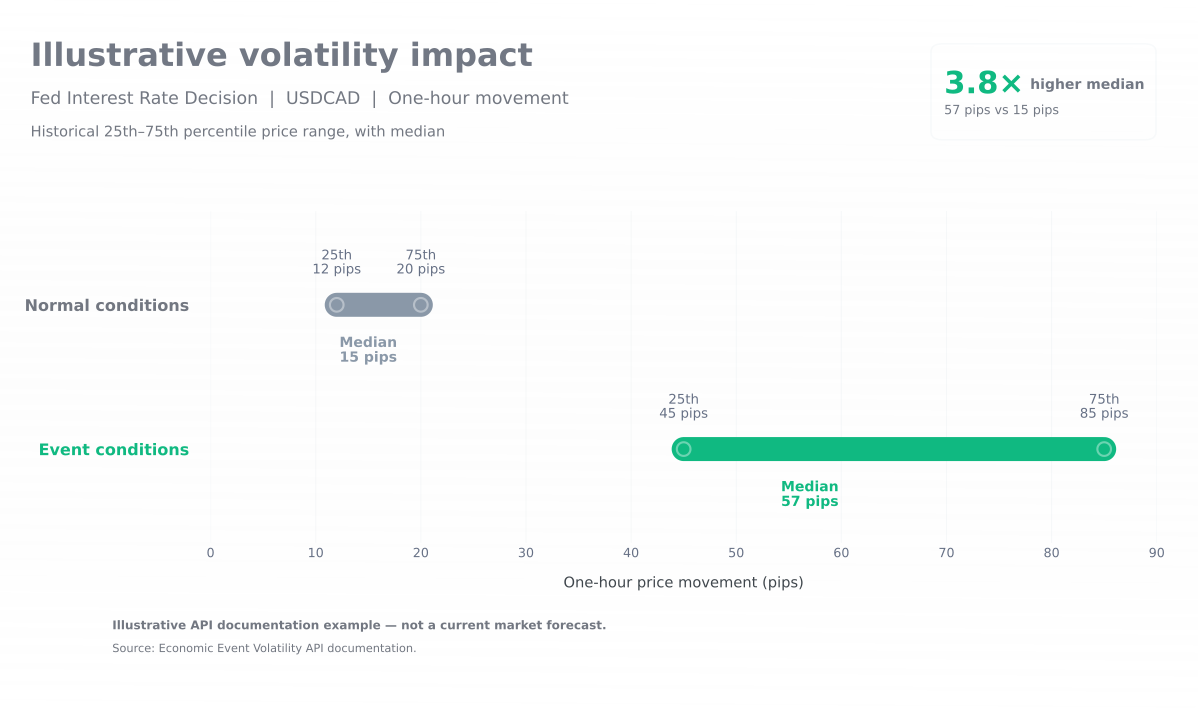
Move beyond generic calendar importance ratings
An economic calendar tells the desk what is scheduled and when it will occur. It does not quantify how trading conditions for a specific currency pair have historically changed around that event. Economic Event Volatility Intelligence turns scheduled releases into a measurable, pair-specific data input. The feed compares price movement during normal and event conditions, helping dealing desks identify the events and instruments that may require additional preparation. The output measures expected movement magnitude—not market direction—and does not prescribe a trading decision.
Prepare earlier with a quantified volatility signal
The feed statistically identifies relationships between supported economic events and FX instruments based on observed market behaviour rather than manual curation. This gives dealing desks a structured, pair-specific signal for event preparation and helps prioritise where policy, pricing and risk controls may need review ahead of scheduled releases.
Key Facts
12 months
Rolling historical lookback
1 hour
Forecast movement interval around the event
Weekly
Statistics refreshed every weekend
7 days
Forward delivery window
18 FX pairs
Current production instrument coverage
61 events
Across nine countries or economic areas
From scheduled event to dealing-desk decision input
For each supported event, the feed provides:
- Event metadata, including country, category, release time and frequency.
- Statistically identified instrument-event associations.
- Instrument metadata and valuation conventions.
- One-hour price-movement distributions for normal and event conditions.
- Sample size, quartiles, median, mean, extrema and standard deviation.
- Movement expressed in price, pips or ticks, approximate monetary value and relative change.
The distributional output allows the desk to evaluate a range of historically observed outcomes rather than rely on a single importance label or point estimate.
Turn event intelligence into dealing-desk preparation
Pricing and spread controls
Inform temporary spread bands, markups, skew limits and quote-size policies when an event has historically produced materially different price behaviour.
Liquidity-pool and routing configuration
Support pre-event reviews of liquidity-pool composition, liquidity-provider weighting, order type and routing policy for affected currency pairs.
Warehousing and hedging policy
Help the desk review internalisation limits, warehouse thresholds, hedge triggers, hedge frequency and permissible open risk ahead of the event window.
Order and execution controls
Inform temporary changes to maximum order size, throttles, slippage tolerances, price collars, reject logic or manual-review thresholds.
Margin, leverage and exposure controls
Add pair- and event-specific context when reviewing margin buffers, leverage settings, position limits or counterparty exposure thresholds.
Monitoring and operational readiness
Prioritise dashboards, alerts, staffing and escalation procedures around the events with the greatest expected impact, then support a controlled return to normal settings after the event.
FX coverage
The production feed currently supports 18 currency pairs:
- AUDCAD
- AUDUSD
- EURJPY
- AUDJPY
- USDCAD
- EURGBP
- EURAUD
- USDJPY
- EURCHF
- USDCHF
- GBPUSD
- EURUSD
- AUDNZD
- NZDUSD
- CHFJPY
- GBPJPY
- GBPCHF
- EURCAD
Economic-event coverage
The production feed covers 61 scheduled events across nine countries or economic areas:
- United States · 21 events
- Australia · 4 events
- Canada · 7 events
- Germany · 6 events
- France · 2 events
- Italy · 3 events
- Japan · 7 events
- Euro Area · 5 events
- United Kingdom · 6 events
Disclosure
Economic Event Volatility Intelligence is based on historical price movement and is provided as an informational decision input. It does not predict market direction, prescribe or execute a trading decision, or guarantee future market behaviour. Brokers remain responsible for their own policies, validation, approvals, controls and use of the data.